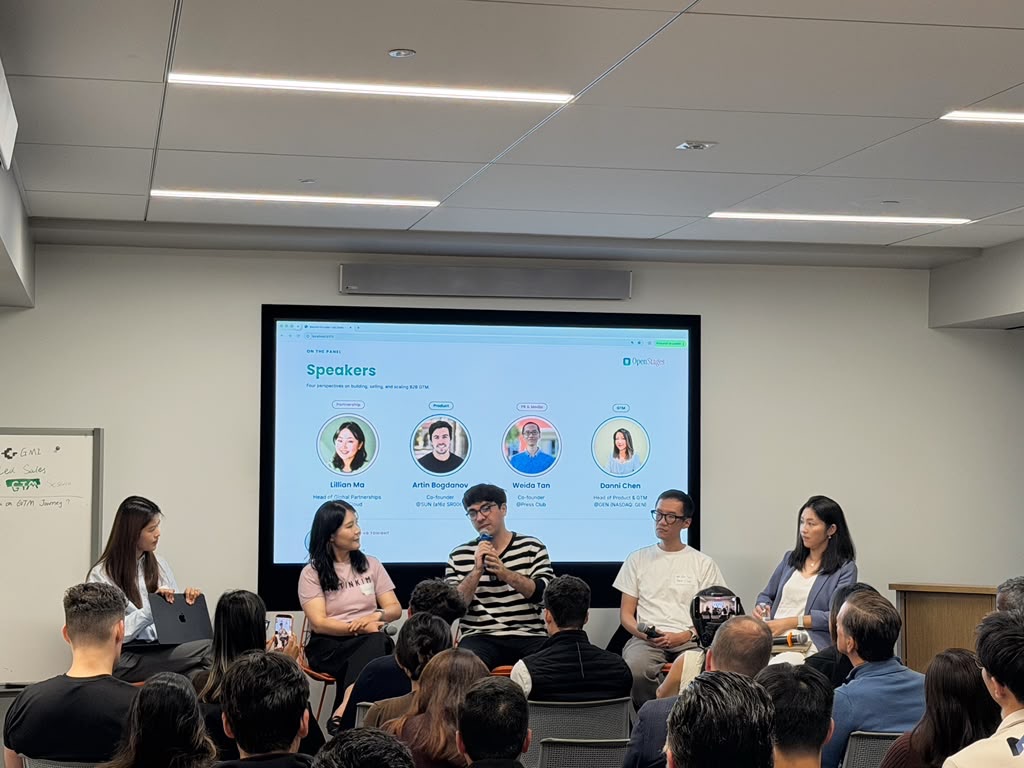
Last week, from October 5 to 11, San Francisco ran another Tech Week. Hundreds of independently hosted events — panels, dinners, demo days, hackathons, morning runs — spread across the city, and the question everyone opened with was not “what do you do?” but “where are you going tonight?” It is worth sitting with that for a moment. In a year when every GTM team has an AI writer, an AI SDR, and an AI video editor, thousands of founders, operators, and investors flew to one city to stand in rooms with each other. That is not nostalgia. It is a market signal about where trust went.
Why online marketing stopped producing trust
Because the internet is now saturated with content that costs nothing to make. About half of new English-language articles and more than half of long LinkedIn posts are classified as AI-generated, so volume, polish, and frequency no longer tell a buyer whether there is a real expert — or a real company — behind the words.
The numbers are directionally consistent across very different studies. Graphite's analysis of Common Crawl found AI-generated articles briefly overtook human-written ones in late 2024 and have hovered around half of new articles since. Originality.ai classified 53.7% of long-form LinkedIn posts from influential profiles in 2025 as likely AI. Detectors are imperfect, and some of that is AI-assisted rather than AI-written — but buyers do not run detectors. They run a much cruder heuristic: “this sounds like everything else,” and they scroll.
Outbound has the same problem in a different channel. AI SDR platforms multiplied the volume of cold email hitting B2B inboxes, inbox providers tightened filtering in response, and buyers learned to pattern-match the “I noticed your company…” opener in half a second. Vendor benchmarks disagree on how far reply rates fell, but nobody's data says they rose. The channel did not die; its signal-to-noise ratio collapsed.
There is a deeper reason this matters, and it comes from economics rather than marketing. A signal is only credible when it is costly to send. A handwritten letter used to mean something because it took time; a 2,000-word thought-leadership post used to mean something because someone had to know enough to write it. Generative AI did not just add noise — it removed the cost that made content a signal in the first place. That is why “post more” has quietly stopped working as a strategy, even for teams that are posting better than ever.
AI didn't make content worse. It made content cheap — and cheap signals stop carrying information.
Where do B2B buyers put their trust now?
In people they can verify. Buyers still do most of their research through digital and AI tools, but they confirm it with humans: Gartner reports that 69% of B2B buyers check AI-generated insights with sales reps, and its 2026 tech-buying research finds buyers spend most of their time on vendors' digital sources while trusting in-person interactions more.
Read Gartner's May 2026 buyer survey carefully, because it looks contradictory at first. The same buyers who want a rep-free, self-service purchase also want a human to validate what their AI research told them. That is not a contradiction. It is the new shape of the funnel: discovery is digital and increasingly AI-mediated, but conviction is formed in a small number of high-trust human moments. Gartner has also found that nearly three in five buyers meet a small or midsize SaaS vendor at an in-person event before buying. The question for a GTM leader is no longer “how do we get more impressions?” It is “how do we create more of those trust moments, with the right people, on purpose?”
What SF Tech Week shows about the new trust market
That demand for in-person signal is exploding — and that volume alone does not create it. Tech Week's San Francisco edition grew to more than 600 events in seven days in 2024, roughly triple the year before. Every role in the ecosystem got something it cannot get online, but the people who got the most out of it were the ones who were selective about which rooms they entered.
Notice who built Tech Week. Andreessen Horowitz is arguably the most media-savvy venture firm in the world — podcasts, newsletters, a partner bench with millions of followers. When the firm that best understands online distribution decided to build its flagship community moment, it built it offline, as a city-wide calendar of physical rooms. That choice tells you more about where attention and trust are moving than any trend report. Here is what each kind of attendee actually walks away with:
What an in-person week gives each role that the feed cannot
- 01
Founders
Compressed time. A week of rooms replaces months of cold outreach: design partners, investors, and early hires in one place, and introductions that come with an implicit endorsement from whoever made them.
- 02
GTM and marketing leaders
Real buyer conversations at scale, and market intelligence you cannot scrape — which problems people bring up unprompted, which competitors they mention, what language they use. That is your next quarter's positioning, for free.
- 03
Investors
Pattern recognition across dozens of founders in days, and the chance to see how a founder holds a room — something no deck reveals.
- 04
Researchers and engineers
Access to the frontier conversation before it is written up, and a talent market where reputation is earned face to face. In AI, a lot of hiring now starts at a meetup, not a job board.
- 05
Enterprise and corporate teams
Scouting. Seeing which startups are real, which founders other founders respect, and where the ecosystem is heading — before it shows up in an analyst report.
But there is a catch, and it is the most important point in this article. Six hundred events in seven days recreates the same noise problem offline. A generic mixer with free drinks and no guest curation is the in-person equivalent of AI slop: lots of contact, very little signal. Attendees learned this fast — which is why the best invitations during Tech Week were application-only, small, and built around a specific question. The scarce asset was never “an event.” It was the right room.
The AI-era marketing stack: three layers, one engine
Modern B2B marketing runs on three layers: curated offline events that create trust, a self-built founder-led voice that creates identity, and content-led SEO that creates reach. Each layer is weak on its own. Run together, the room produces the stories, the founder carries them, and the content makes them findable for years.
What each layer does — and where it fails alone
Layer 1 — Offline events: the trust engine
Events are the one channel where trust is created rather than claimed. Being chosen to speak, being in a curated room of peers, and having an unhurried conversation over dinner are signals AI cannot forge. The format matters less than three things: a specific theme, a curated guest list, and a plan for what happens after the room.
Most companies get events wrong in one of two ways. They sponsor a big conference and buy a booth — expensive, crowded, and full of badge scans from people who will never buy. Or they throw a happy hour that attracts whoever was free that night. Both optimize for headcount. The rooms that actually move pipeline optimize for fit: thirty of the right founders beat three hundred of the wrong ones, every time.
- Pick one sharp question, not a category. “How do you get from founder-led sales to a repeatable motion?” fills a room; “AI and the future of work” does not.
- Make it application-only. Screening is not elitism — it is the promise to every guest that the person next to them is worth their evening.
- Give the stage to practitioners. Your best speakers are often your customers and the founders your buyers already admire. Your own sales pitch belongs in the follow-up, not on stage.
- Design for conversation. Seated dinners, roundtables, and small panels with real Q&A outperform a keynote and a crowded bar.
- Plan the after before the during. Who follows up with whom, what gets written up, which clips get cut — decided before the doors open.
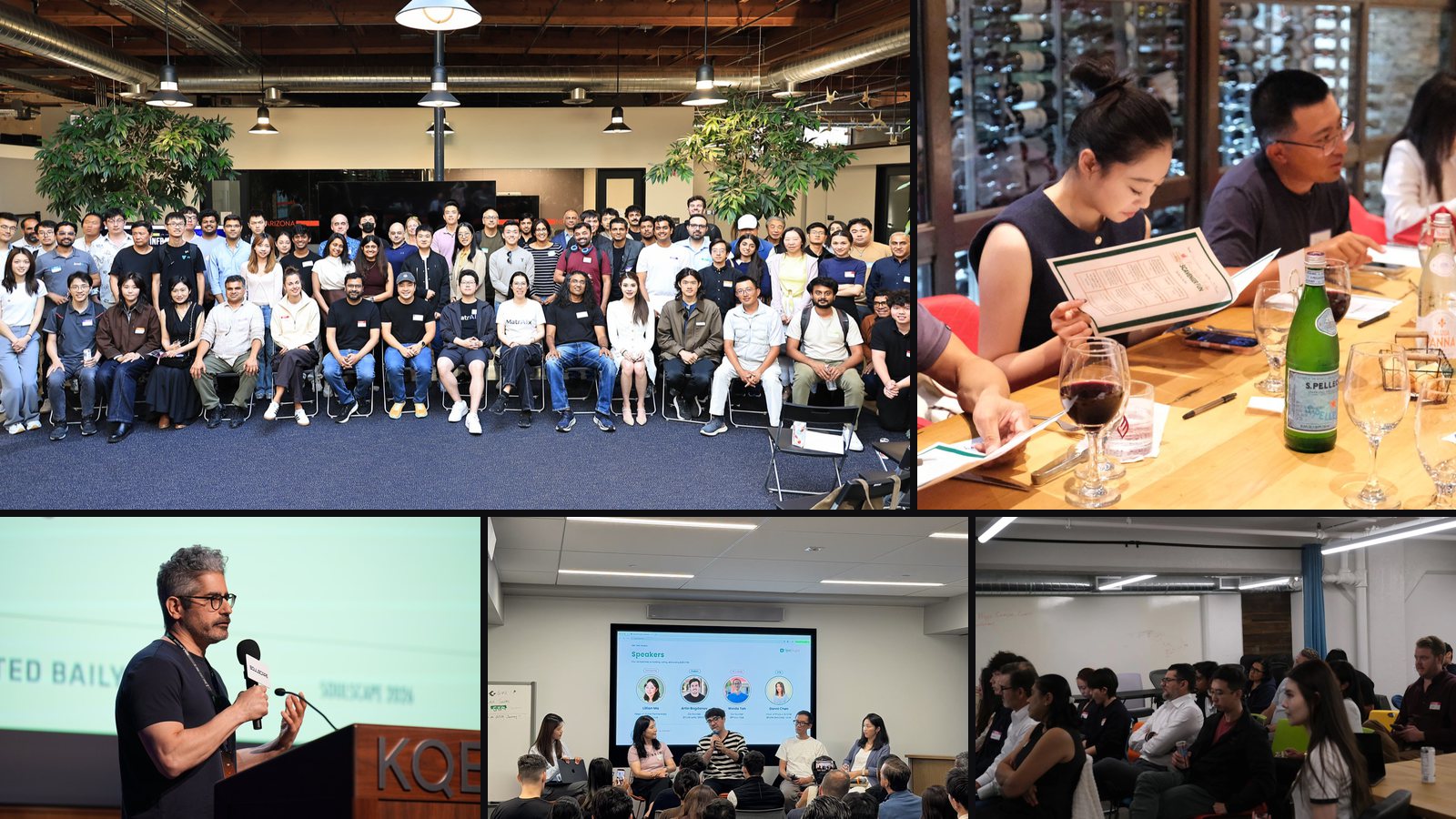
This is the work we do at OpenStages. We run application-only rooms in San Francisco and the Bay Area for founders, operators, AI researchers, and investors — and we run them with partner companies who want to be at the center of a specific conversation. A few recent examples: a private founders dinner with Chargebee and Numix for around 30 founders at similar stages; Beyond Founder-Led Sales, a closed-door GTM session with GMI Cloud and Cole-Frieman & Mallon where 105 founders answered a pre-event survey that shaped the agenda; a five-hour AI infrastructure gathering of around 100 builders in Sunnyvale; and, at the other end of the scale, Soulscape 2026, a three-day AI film summit at KQED with 1,000 attendees. Different sizes, same rule: the guest list is the product.
Layer 2 — Founder-led, self-built: the identity layer
Founder-led marketing means the founder's own point of view becomes the company's main marketing channel. It works in the AI era because a specific, opinionated, verifiable human is the one thing a model cannot generate. It fails the moment the founder runs out of first-hand material — which is why it needs a steady supply of real conversations.
Every GTM leader has heard “the founder should post more.” The problem is rarely willingness; it is material. A founder who spends the week in product reviews and investor updates has nothing new to say on Friday, so the post becomes a reworded lesson everyone has read before — and now sounds like everyone's AI assistant too. The founders whose content cuts through write from a stream of fresh, specific, first-hand experience: what a buyer said in a room last Tuesday, what three founders disagreed about at dinner, the question nobody on the panel could answer.
That is the quiet link between layer one and layer two. A stage gives a founder a credible reason to speak. A curated room gives them stories nobody else has. One forty-minute panel can become a month of posts, a long-form essay, and a set of clips — we wrote up how in turning one talk into a month of content, and why this compounds into founder personal IP. “Self-built” here does not mean doing everything alone. It means the voice, the opinions, and the receipts are genuinely the founder's; the team and partners handle production.
- Opinions with receipts beat generic advice. “We lost three enterprise deals to procurement, here is what we changed” is worth ten posts about resilience.
- Show up where the conversation is physical, then extend it online. Post from the room, not about the industry.
- Hold a cadence the founder can actually keep — one strong post a week from real material beats daily AI-assisted filler.
- Speak on other people's stages before you build your own. Being invited is itself a trust signal.
Layer 3 — Content-led: the reach and compounding layer
Content-led growth still works, but only for content that contains something AI cannot produce: original data, first-hand stories, named people, and specific outcomes. Search engines and AI assistants increasingly surface and cite exactly that kind of source, while generic AI-written pages struggle to rank at all.
Graphite's own research noted that most AI-generated articles do not show up prominently in Google or ChatGPT results. That is the opportunity hiding inside the noise. When buyers ask an AI assistant “how do B2B founders move beyond founder-led sales?” the answer is assembled from sources with real specificity — survey numbers, named speakers, concrete playbooks. A recap of a curated event is almost a perfect content asset by that standard: it contains a real audience's data, real practitioners' quotes, and a real date and place. Nobody else can publish it.
- Survey every guest list and publish the aggregate. 105 founders telling you their biggest GTM blocker is original research; your competitors cannot copy it.
- Write the recap as answers, not a diary. Each section should answer a question buyers actually search for, with the answer in the first two sentences.
- Name and link the people. Speakers share pieces they appear in, and named expertise is what AI answers like to cite.
- Keep a topic hub. Ten recaps on one theme turn into category authority; ten unrelated posts turn into a blog nobody reads.
How the three layers turn one event into a quarter of GTM
Run the event as the center of a 90-day cycle: the weeks before generate research and anticipation, the night itself generates trust and raw material, and the weeks after convert that into founder content, SEO pages, and pipeline follow-up — which then fills the next room.
The event-led GTM flywheel
- 01
Weeks −4 to 0: build the room in public
Announce the theme, open speaker applications, survey applicants. The speaker call is itself content; the survey becomes your original data. The founder posts about the question the room will answer.
- 02
The night: create trust and capture material
Curated guests, a moderated stage, unhurried conversation. Capture photos, quotes, and the questions people ask — with permission, and with an off-the-record line where it makes the room more honest.
- 03
Weeks 1–2: follow up while it is warm
Personal follow-ups from the people who actually talked, not a blast from marketing automation. Introductions you promised. This is where the pipeline is.
- 04
Weeks 2–8: publish and distribute
A recap page built for search, a research digest, speaker clips, and a run of founder posts from what was said in the room. Each piece links back to the others and to the next event.
- 05
Week 8 onwards: open the next room
Last event's guests, readers, and content become the next invitation list. The flywheel compounds: every cycle starts with more trust than the last.
Why San Francisco, and why now
Because density compounds trust. The Bay Area concentrates AI builders, venture capital, and early-adopter buyers more than anywhere else, so a single well-curated room can hold a disproportionate share of your category's future customers, partners, and hires. Tech Week happens once a year; the city runs rooms like this every week.
If Tech Week taught one lesson, it is that everyone is already coming to San Francisco to meet in person. The opportunity for a GTM team is not to fight for attention in the busiest week of the year, when 600 other events compete for the same calendar. It is to own a specific conversation in the 51 quieter weeks, when your guests are not double-booked and actually stay for dessert. Companies that start now will have run four or five cycles of the flywheel by the next Tech Week — with a guest list, a body of content, and a reputation their competitors will be trying to buy a booth to approximate.
Tech Week is once a year. The right room in San Francisco is available every week — and nobody is double-booked.
A 30-day plan for GTM leaders and founders
- Days 1–5: Write down the one question your best customers wish someone would answer. That is your room's theme.
- Days 5–10: Build a list of 60 people you would most want in that room — customers, prospects, respected founders, one or two investors. Aim for 25–40 to show up.
- Days 10–15: Choose the format. Under 40 guests: a seated dinner or roundtable. 40–120: a moderated panel with curated networking. Choose a co-host whose audience overlaps yours but who does not compete with you.
- Days 15–25: Open applications, survey every applicant, line up two or three practitioner speakers, and have the founder post about the question in public.
- Day 30: Run the room. Then publish the recap within a week, while every guest still wants to share it.
Or skip the operational part. OpenStages handles concept, guest curation and screening, speaker sourcing, moderation, venue and production, and the post-event content — so your team spends the night in conversation with buyers instead of checking a guest list at the door. Partners co-host with us when they want a room of qualified founders and operators in San Francisco rather than another booth.
Start here
Frequently asked questions
What is the best B2B marketing strategy in the AI era?
Combine three layers instead of betting on one channel: curated in-person events that build trust with the right people, a founder-led voice built on genuine first-hand experience, and content-led SEO built on original data and real stories. AI-generated content and automated outreach have made purely online channels noisy, so the strategies that win are the ones that create signals AI cannot fake.
Are in-person events worth it for early-stage startups?
Yes, if they are curated rather than generic. A seated dinner for 25 of the right people often produces more qualified pipeline than a conference booth, at a fraction of the cost, and it produces content and relationships that compound. The mistake is optimizing for attendance instead of fit.
What is founder-led marketing?
Founder-led marketing makes the founder's own point of view the company's primary marketing channel — posts, talks, essays, and conversations in the rooms buyers attend. It works because buyers trust a specific, accountable person more than a brand account, especially now that most generic content can be machine-written.
Do we need to be based in San Francisco to run events there?
No. Many of our partner companies are based elsewhere and use a San Francisco room to meet Bay Area founders, buyers, and investors in a single evening, often timed around a team trip. We handle local production and guest curation so a remote team can simply show up.
How does OpenStages work with companies?
We co-design a room around a question your audience cares about, curate an application-only guest list, source and moderate speakers, run the production, and publish the content afterwards. Formats range from private founders dinners to panels and multi-day summits. Reach out through the contact form on this page with the audience you want to meet, and we will propose a format.