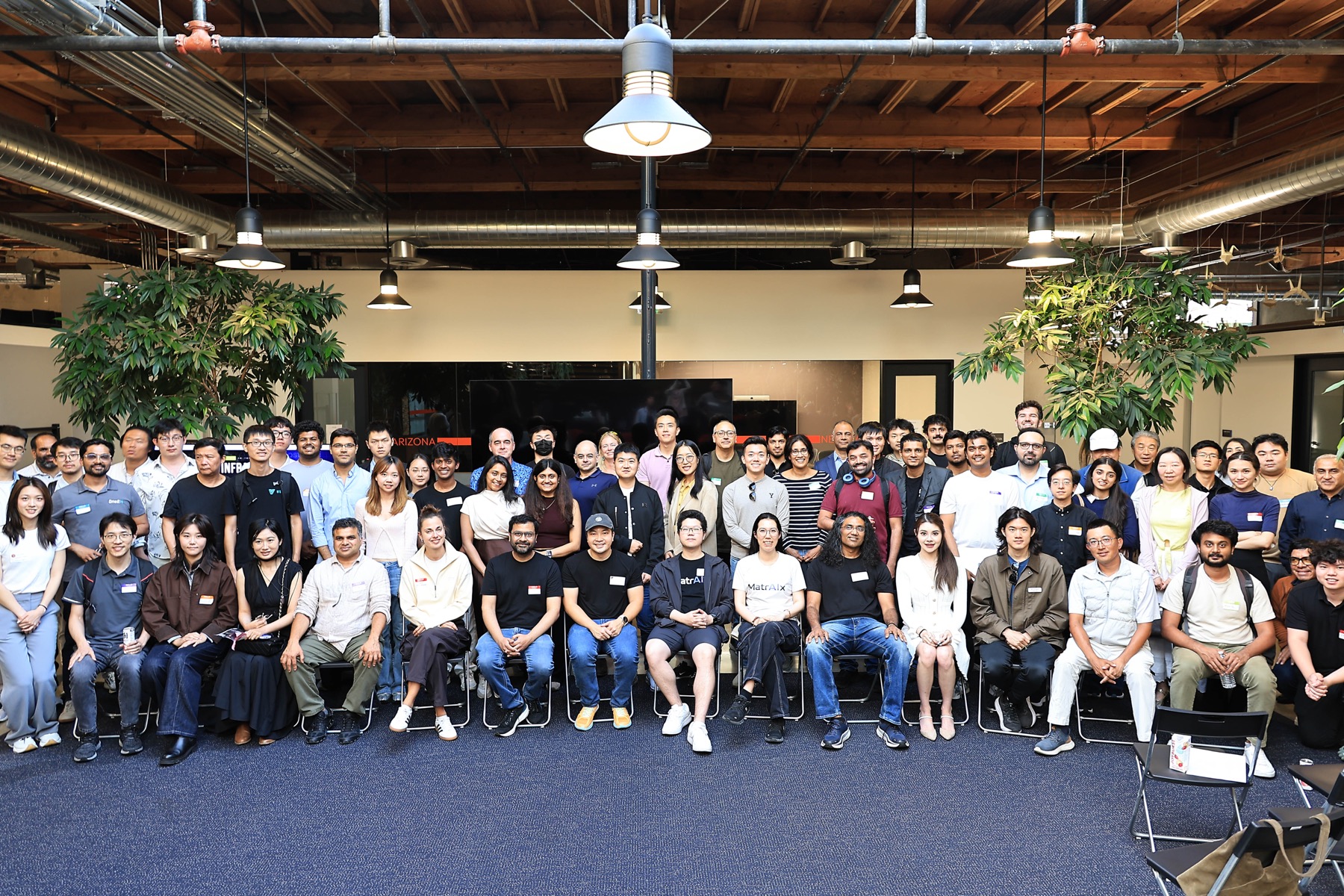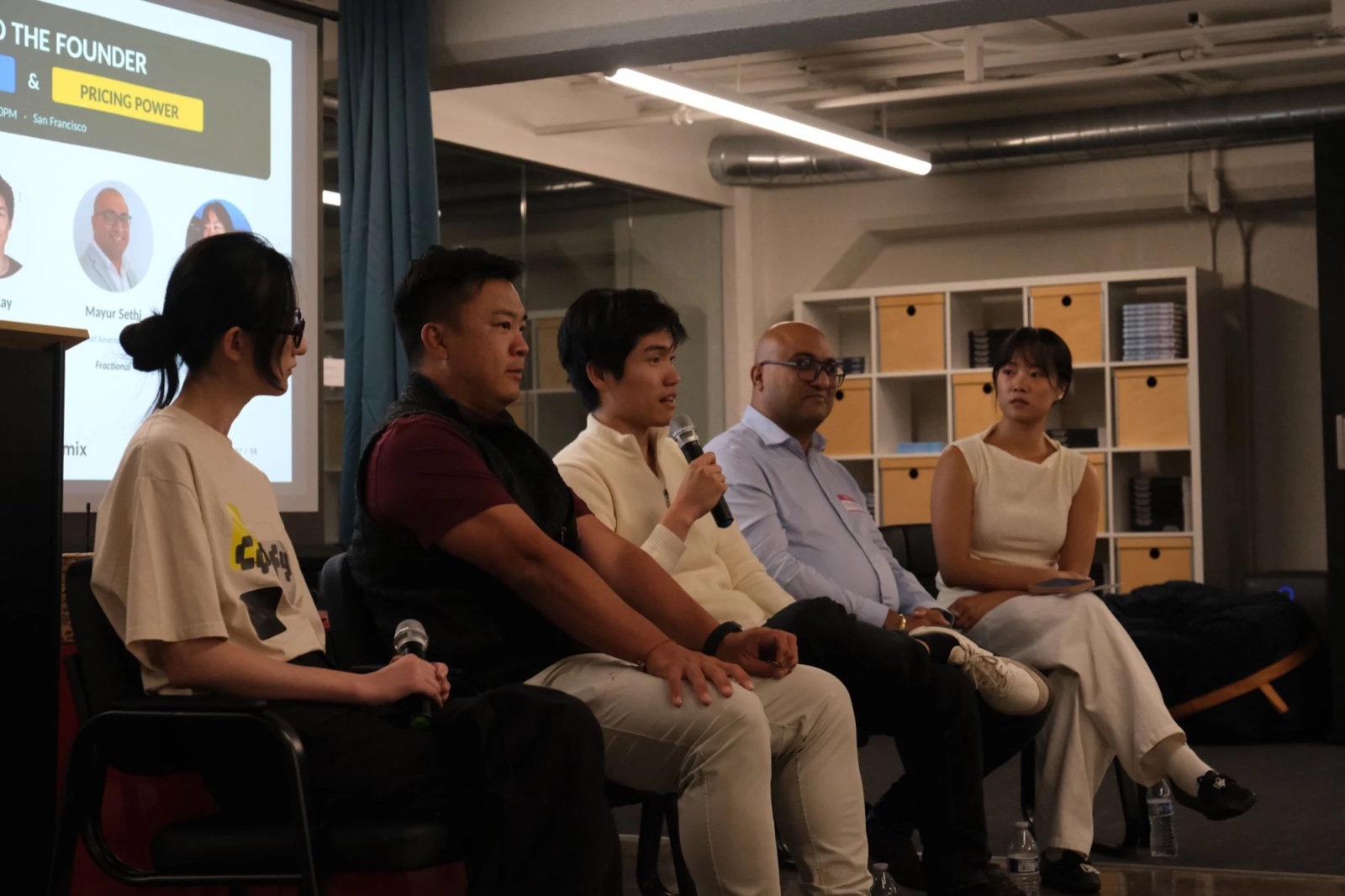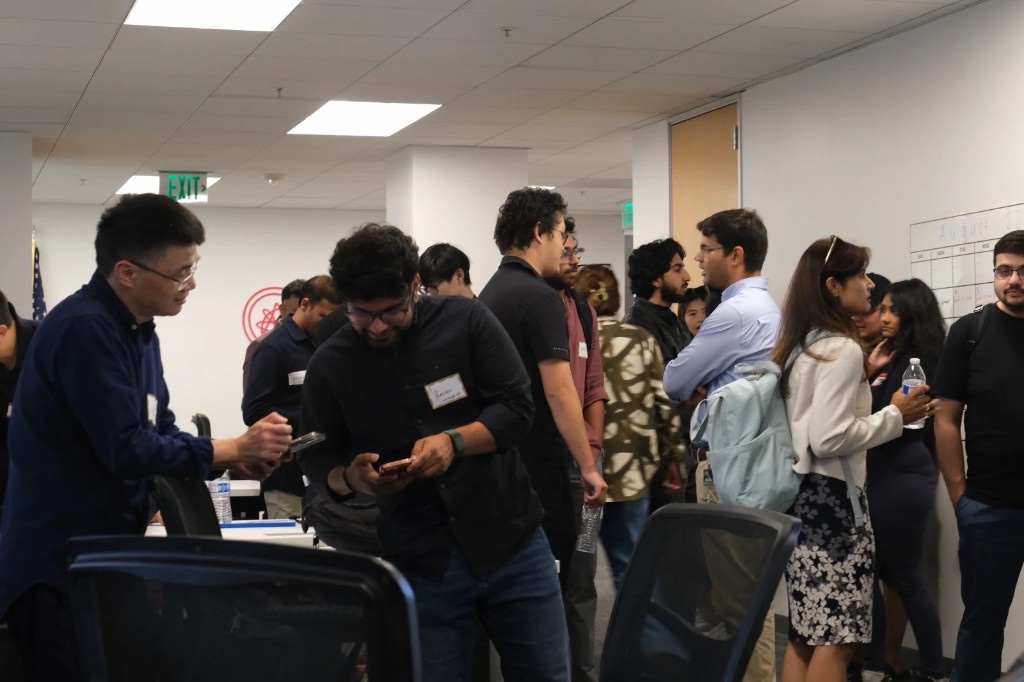

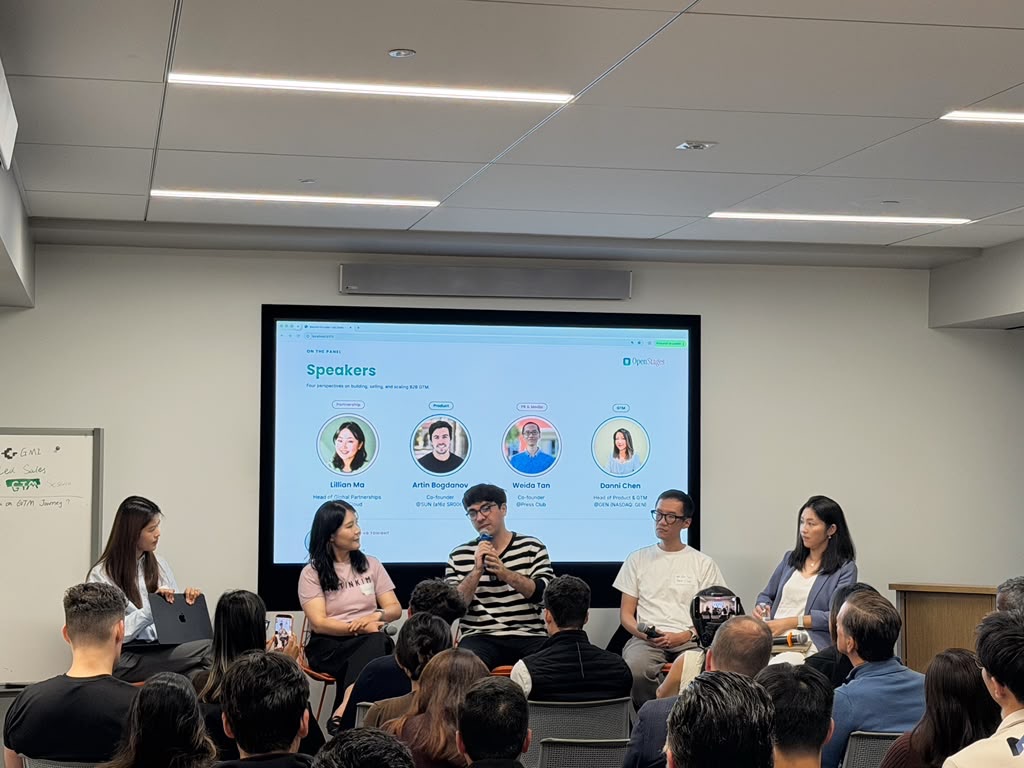
Most founders think the handoff is triggered by a revenue number. The four operators on our panel on July 31 all landed somewhere else: you are still founder-selling until the motion exists outside your head — a defined ICP, a discovery playbook someone else could run, and at least one channel producing pipeline you did not personally source. Beyond Founder-Led Sales was a closed-door session in San Francisco hosted by the OpenStages team, sponsored by Cole-Frieman & Mallon LLP and GMI Cloud. No recording, no livestream, no pitch deck theater. This is the written version of what the room concluded.
What 105 founders said before the room opened
Most of them had revenue and were still selling it themselves. 64.8% were generating revenue, 78.1% still ran growth through the founder, and their top three blockers were pipeline and attention (34.5%), enterprise deals (23.6%), and turning founder-led sales into a repeatable process (20%).
We survey everyone who registers for an OpenStages GTM session and publish the aggregate back to the room, so the agenda comes from what the audience is stuck on rather than what four speakers feel like discussing. The short version of this one:
- Stage — 64.8% already had revenue; 20% were funded but pre-revenue.
- GTM mode — 43.8% founder-led only, 34.3% founder-led plus early hires. Under 4% were PLG.
- Biggest blocker — pipeline and attention 34.5%, enterprise deals 23.6%, turning founder-led into repeatable process 20%.
- What they build — 26% AI infra and dev tools, 17% enterprise vertical AI: technical products sold to technical or enterprise buyers.
That last combination is the trap. Founder credibility converts best exactly where it scales worst. So the night ran on three questions: have I found a real ICP and a need that repeats? Can what the founder sold be sold again — by someone else, through another channel? Does growth stay efficient as customers, budget, team, and complexity all increase? Positioning, repeatability, scalability. Everything below hangs off one of those three.
When should founder-led sales actually start?
Before the product is finished. Selling starts during customer interviews: the founder cares most and knows the product best, which makes the first hundred conversations both the research and the pipeline. Waiting for a version you are proud of spends the only asset you have at that stage — time in front of buyers.
The counter-argument technical founders always raise is that they are not salespeople. The panel's answer was that authenticity outperforms polish at this stage. A founder who can explain exactly why the current tooling is broken, and who visibly cares, converts better than a trained rep reading a script. What kills technical founders is not lack of charisma. It is treating outreach as something to do after the code is done.
- Launch before it is ready and let user feedback replace your roadmap guesses.
- Do the unscalable work early — hand-built demos, in-person meetings, personal onboarding — because it is also your fastest research loop.
- Keep short, genuine outreach over templated sequences; a two-line message that names the buyer's actual problem beats a polished paragraph.
- Stay in offline rooms. Cold outreach is a numbers game; a warm room is a conversion game.
Your ICP is in behaviour, not in what prospects tell you
Read behavior instead of stated interest. Start with an empathy map of where your buyer already congregates, then rank accounts on four signals: how fast a trial burns credits, whether they file support tickets during evaluation, whether the second demo has more people on it than the first, and whether the urgency came from their deadline rather than your follow-up.
Behavioral intent signals the panel actually trusts
- 01
Trial burn rate
How fast a trial account consumes credits, and which model or tier they choose. Someone burning through the plan in three days has a real workload, not curiosity.
- 02
Support tickets during evaluation
Technical support requests in a trial are the single most underrated buying signal. People do not debug a tool they are not planning to depend on.
- 03
Multi-participant demos
When the second demo has four people on it, someone internally has already decided to advocate. Map who they brought — that is your buying committee, for free.
- 04
Urgency language
Deadlines, budget cycles, compliance dates, a competitor announcement. Urgency you did not create is the difference between a deal and a pilot that never closes.
For product-market fit, the room used two tests. The qualitative one: are people using it compelled, despite obvious flaws? Broken onboarding, missing features, ugly UI — and they still come back. The quantitative one: the classic survey asking how disappointed users would be if the product disappeared, looking for 40% or more answering “very disappointed”. One founder was candid that their early period included 100% churn before the shape of the product changed. Grit and honesty beat pretending.
PMF is not when people say they love it. It is when they keep using it while complaining about it.
Pick channels on LTV/CAC — and know when to kill one
Test several channels briefly, then master one or two. A channel earns its place on four numbers: LTV/CAC around 3:1 or better, activation above 20% of signups reaching first real value, payback under twelve months, and funnel conversion tracked per channel rather than blended. Below those, growth is a subsidy — kill the channel instead of optimising it.
The most common mistake in the room was chasing whichever channel was working for someone else on LinkedIn last month. Mastery of one channel outperforms mediocrity across five.
The numbers that decide whether a channel survives
Once one or two channels are working, build loops on top of them: content that compounds, viral or referral mechanics, and community. Diversification comes later — and at later stages, partnerships become the cheapest acquisition channel available. The exercise the panel recommended is almost embarrassingly simple: take your top ten clients, write down exactly how each one was acquired, and double down on whatever pattern appears more than twice.
Long B2B sales cycles came up as a complaint and were reframed as a moat. If it takes nine months and three stakeholders to win an account, it takes your competitor nine months too — and the incumbent you displaced is not getting back in easily. Several teams in the room reported that community partnerships and in-person events outperformed every paid channel they had tried.
How do early-stage startups close enterprise deals?
Map three roles separately — who uses the product, who pays for it, and who is accountable if it fails — then build a sequence of repeated, meaningful touches rather than a follow-up cadence. Equip an internal champion, host small high-signal events near where your buyers already gather, and in regulated industries start with junior stakeholders who route you upward.
Enterprise procurement was the second-biggest pain in our survey at 23.6%. The three roles are rarely the same person, and a deal dies when you have only threaded one of them. A follow-up cadence asking whether they had a chance to review the proposal is not a sequence of meaningful touches.
- Find and equip an internal champion; your job is to make them look good in a meeting you are not in.
- Host small, high-signal events near where your buyers already gather — a targeted happy hour at a conference like NeurIPS beats a booth.
- Monitor your target accounts' public announcements, then build a fast, aligned demo. A prototype that speaks to their stated strategy opens doors a cold email cannot.
- Start with junior stakeholders in regulated industries. They have time to talk, and they route you upward with internal credibility attached.
For regulated sectors — healthcare, finance, public sector — the room favored authority by association: partner with the publishers and foundations the buyer already trusts, deliver genuine value to them, and let content-led trust and warm introductions do the work. Cold approaches at conferences in these categories were described as actively risky. Field marketing works, but only once accounts are already active.
Does PR actually drive B2B pipeline?
Rarely directly. Tier-one media buys credibility and access — accelerator programs, candidate shortlists, investor inboxes — while vertical and trade outlets are where purchase intent lives, because the reader is already in-market. The craft matters more than the channel: ordinary cold pitches to journalists get roughly a 0.5% response rate, genuinely exceptional ones around 10%.
Founders conflate the two and then judge a TechCrunch hit by demo requests. The twentyfold gap between ordinary and exceptional cold pitches is entirely determined by the craft of a single email — a specific story, real data, a reason it matters this week. Several founders in the room traced a fundraise or a key hire directly back to one announcement.
The tactics that actually moved numbers
The human, slightly strange ones. A branded van touring during the World Cup outperformed the paid campaign running alongside it, physical direct mail secured meetings email could not, parallel submissions to Product Hunt-style directories built durable backlinks, and engaging on LinkedIn roughly ten minutes before posting decided how far the post travelled.
The through-line is not cleverness — it is that a human, slightly strange gesture cuts through polished noise, because polished noise is now free and infinite.
- Event-tied stunts: a branded van touring during the World Cup generated more attention than the paid campaign running alongside it.
- Physical direct mail: novel thank-you cards and unexpected packages produced measurable traffic and secured meetings that email could not.
- AI-assisted multi-platform launches: submitting to Product Hunt and dozens of similar directories in parallel builds backlinks and durable SEO.
- LinkedIn timing windows: engage with your network roughly ten minutes before you post and within thirty minutes after; early engagement from a few relevant voices decides distribution.
The first GTM hire comes after the playbook, not before
When two conditions are true at once: the engine works — a defined ICP, a discovery playbook someone else could run, at least one channel producing repeatable pipeline — and the founder's calendar has become the constraint on growth. Hire before the first and the rep churns in six months. Hire after the second and you have already been the bottleneck for a quarter.
This is the question 78.1% of our respondents are living inside. One speaker put the second condition more bluntly: you are bleeding. The handoff itself is a process, not a hire.
The handoff, in order
- 01
Write down what you do
Discovery questions, objection responses, the exact sequence of a deal that closed. If it only exists in the founder's head, it is not a process — it is a dependency.
- 02
Hire for your gap, not your comfort
Founders hire people like themselves. The point of a GTM hire is to cover the motion the founder is worst at.
- 03
Keep the founder on why and what
The CEO stays in major deals and owns strategy and narrative. Day-to-day execution moves to the team, or nothing has actually changed.
- 04
Institutionalize the learning
Bi-weekly lunch-and-learns where wins and losses get dissected. Shared context is what turns a GTM team into owners rather than order-takers.
The cultural version of this point is the one founders resist most: scaling requires moving from founder-centralized decisions to empowered GTM teams. The room was clear that a strong founder brand is an asset early and a single point of failure later. If every deal needs you in the room, you have not built a GTM engine. You have built a very good calendar.
Who was on stage
Beyond Founder-Led Sales was hosted by the OpenStages team and moderated by Lika Li, with four panelists chosen for range rather than agreement: Lillian Ma, Head of Global Partnerships at GMI Cloud, on partnership-led acquisition; Artin Bogdanov, co-founder of SUN and a16z speedrun SR006, on founder-led sales at the earliest stage; Weida Tan, co-founder of Press Club, on PR and media as a GTM channel; and Danni Chen, Head of Product & GTM at GEN (NASDAQ: GEN), on what changes at enterprise scale. Sponsored by Cole-Frieman & Mallon LLP and GMI Cloud.
Come to the next one
Frequently asked questions
How do I get invited to an OpenStages GTM session?
Our sessions are closed-door and capped, and we announce every one through our Luma calendar and LinkedIn page. Subscribe to the calendar to get the registration link when it opens. If you would like to be on the panel rather than in the audience, apply through our speaker opportunities — we look for a specific, first-hand GTM story rather than a general profile.
Can my company host or sponsor a GTM room like this?
Yes. Beyond Founder-Led Sales was run with Cole-Frieman & Mallon LLP and GMI Cloud. We handle the concept, the pre-event research, speaker curation, moderation, and the post-event content — companies partner with us when they want a room of qualified founders and operators rather than a booth full of badge scans.
How do I apply to speak at an OpenStages session?
Every OpenStages room holds a small number of speaker seats, filled from open calls rather than a fixed rolodex. If you have run a specific GTM motion — a channel you scaled, an enterprise deal you should not have won, a launch that failed instructively — that is the kind of story these rooms are built from. Browse the open calls and apply with proof.