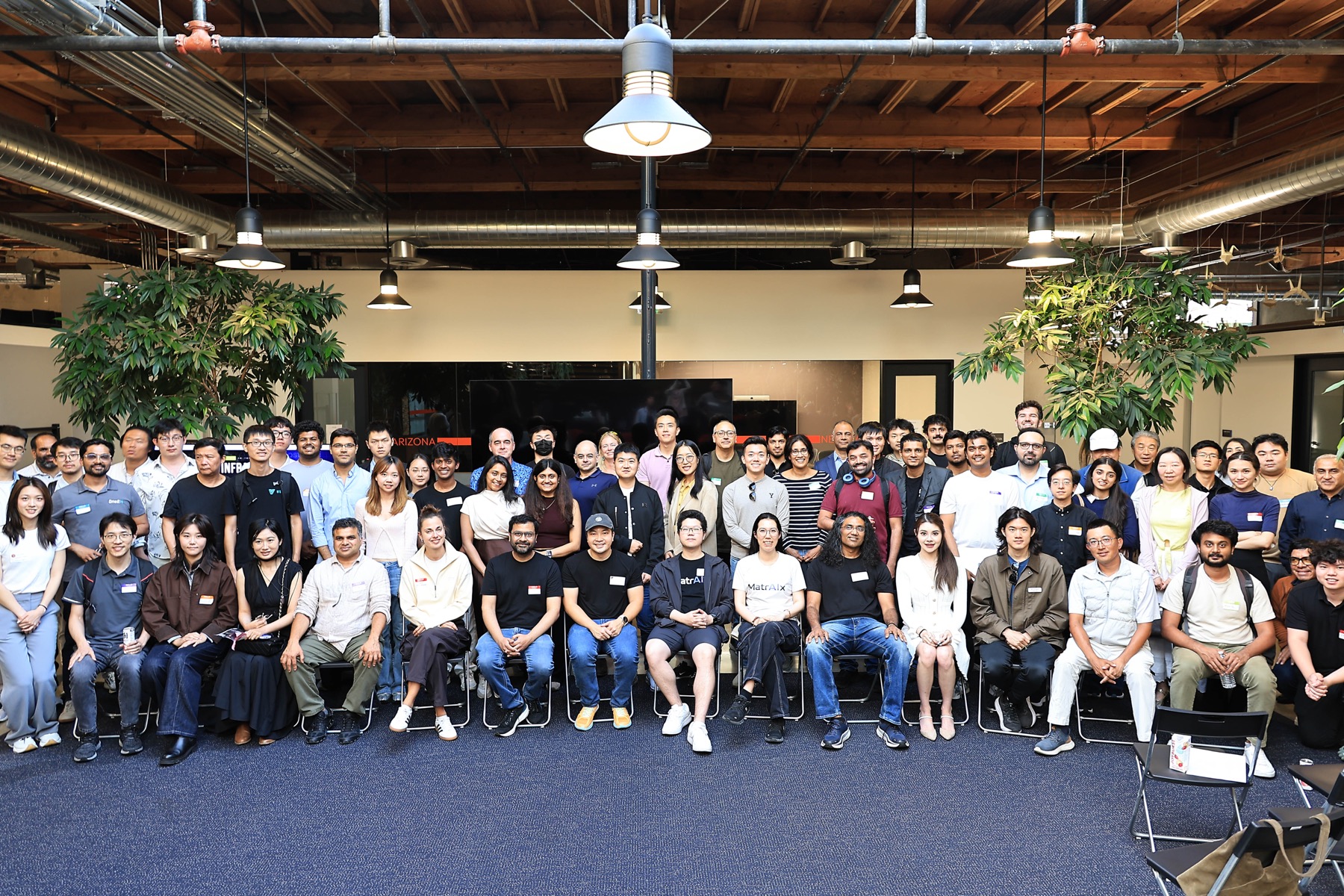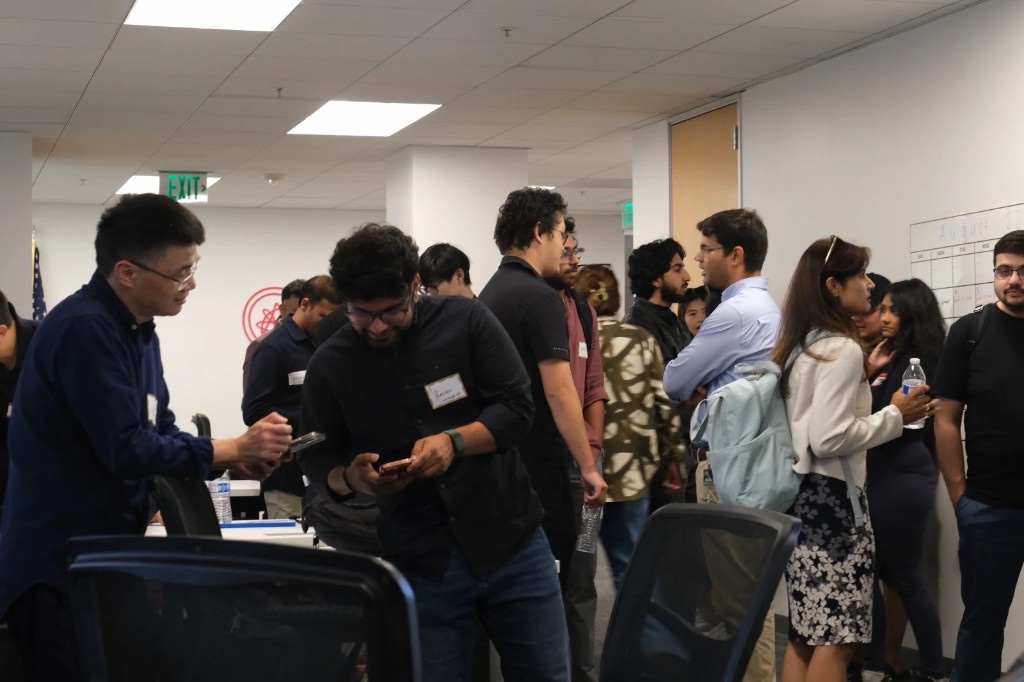
On August 6, 2026, ten AI-native companies each took three minutes in a closed room in Redwood City. No judges, no rankings, no winners — just what you are building, why it matters, and what you have learned, then an open conversation with the room. This is who was there, and why we keep building evenings like it.
The researchers decide what's possible. The founders decide what becomes real. The capital decides what comes next.
Which companies presented at AI Tech Salon Night?
Ten AI-native companies across four sections: BitterClip and Visually in Creative Media; Teyon.ai and ZETIC in AI Infrastructure; Rome and Kidooo AI in Human-Centered AI; and FocusAlpha, Klaris, Zentrik, and Manufex in Enterprise AI.
Creative Media
- 01
BitterClip — Michael Ruescher, Founder
An AI-native platform for understanding and editing long-form video. BitterClip turns raw footage into a structured, searchable representation that AI agents can reason over, so teams can find important moments, analyze events, and cut finished edits. The live product is already used by paying customers across creator, coaching, and multi-camera footage.
- 02
Visually — Nasa Dadkoush, Founder
The Lovable for explainer videos: a platform purpose-built for making explainer videos, with fully editable scenes rather than a fixed render you cannot take apart.
AI Infrastructure
- 01
Teyon.ai — Tongping Liu, Founder
The reliability layer for GPU training infrastructure. Deterministic record-and-replay runs in production clusters at roughly 2% overhead. When a training run fails, Teyon recovers it in place instead of restarting from a checkpoint — and explains exactly why it failed from captured ground truth.
- 02
Human-Centered AI
- 01
Rome — Yunfan Ye, Founder
A personal agent OS that builds, installs, and runs software for you. Other tools generate orphan apps; Rome grows living software that remembers, reacts, and evolves alongside the person using it.
- 02
Kidooo AI — Hao Xue, Founder
Video intelligence for child development and parent intervention — a multi-model, two-stage video analysis system built to help parents understand what they are seeing and act on it.
Enterprise AI
- 01
FocusAlpha — Jennifer Ma, Founder
Trusted, complete company intelligence for your AI. Gives Claude or Codex reliable company research instead of random web pages — lower token usage, better answers, in one click.
- 02
Klaris — Alam Khan, Founder
An AI-native insurance agency, built on the bet that the agencies of the future are powered by AI agents that own and execute the entire insurance distribution workflow.
- 03
Zentrik — Jorge Alcantara, Founder
Choose the best product bet, and carry the customer reason all the way to production. Zentrik connects roadmap bets to calls, tickets, market signals, and product data in a living loop, so evidence and intended outcomes stay intact through delivery. AI helps do the work; people own the call.
- 04
Manufex — Abhishek Devanga, Founder
Procurement AI for custom manufacturing, from CAD to your door. Manufex routes every job across CNC, sheet metal, 3D printing, and injection molding, with AI agents and a real project manager watching the whole way.
Also in the room
Two more founders were in the room without a main-stage slot: UltraBeing, an AI doctor for mental and metabolic health, and Casola, a real-time conversational layer for agentic AI.
- UltraBeing (ultrabeing.ai) — Zinnia Hashmi, Co-founder & CPO. The AI doctor for mental and metabolic health.
- Casola — Alexander Pucher. The real-time conversational layer for agentic AI.
Why put researchers, founders, and investors in one room?
Because these three groups almost never get unhurried time together. Researchers publish, founders ship, investors take meetings — and the tracks usually only cross inside a transaction, when everyone is already performing a role. An evening where nobody has to sell anything is where the more useful conversation happens.
That is the whole reason we build these rooms. An ecosystem is not a list of companies; it is how well the people in it actually know each other. When a founder can ask a researcher what is genuinely close and what is still years out, when a researcher can see where their work lands once it leaves the lab, when an investor can meet someone a year before there is anything to decide — those conversations compound. Most of them pay off long after the evening they started in.
What each side of the room takes home
- 01
For founders
You hear what is actually possible from the people building the underlying systems, before you commit a roadmap to it. And you meet operators, peers, and investors at a moment when you are not asking them for anything — which is the only time those relationships start easily.
- 02
For researchers
You see which of your constraints matter once something has to run in production, what founders are trying to build on top of your area, and which problems the market will actually pay to solve. It is the fastest feedback loop between a lab and a customer that exists.
- 03
For investors
You meet founders before a process — explaining what they are still stuck on rather than narrating a deck — and you hear researchers say plainly which approaches are real. Both are hard to get from a warm intro and a pitch meeting.
The room, by the numbers
106 people: 113 founder profiles across nine industry clusters, 28 researcher profiles across six research directions, and investors deploying from pre-seed through Series B — both VC and CVC.
The range is the point. It is why a three-minute introduction is enough to find the person you needed to meet — someone in the room has almost always already worked on the thing you are stuck on. From the registration export, deduplicated by LinkedIn, the founder profiles (n=113) grouped by primary field:
- AI infrastructure and developer tools — 22
- Enterprise workflows — 16
- Health and life sciences — 13
- Fintech, commerce, and legal — 13
- Media, education, and creative — 12
- Agents and general AI — 11
- Consumer and personal AI — 11
- Physical AI and industry — 8
- Other / not specified — 7
And the researchers in the room (n=28), grouped by primary direction:
- AI systems, infrastructure, and agents — 7
- Safety, alignment, and evaluation — 5
- Multimodal, spatial, and robotics — 5
- Applied AI and domain systems — 5
- Foundation models, NLP, and post-training — 3
- Health and clinical AI — 3
What ten pitches in one night told us
Three things stood out: nobody was building a foundation model, several companies were building for an AI agent rather than a person, and two were becoming the service outright instead of selling software to it.
The clearest pattern was who the customer is. BitterClip structures footage so that AI agents can reason over it. FocusAlpha exists to feed Claude and Codex something better than random web pages. Rome runs software on your behalf. Zentrik hands AI builders grounded context instead of a ticket. In four of the ten pitches, the thing being served was a model, not a human — and none of the four described it as a feature.
The second was where the infrastructure work has moved. Neither infra company is training anything. Teyon.ai keeps a training run alive when it fails at scale; ZETIC gets a model that already exists onto a hundred real handsets. That is the unglamorous half of the stack — and it is where the room's technical questions were sharpest.
The third was a shift in what an AI company even is. Klaris is not selling software to insurance agencies; it is an insurance agency. Manufex is not a procurement tool; it routes real manufacturing jobs and staffs a project manager behind the agents. Both are taking the margin of the service business rather than the seat price of a SaaS product.
And the registration data pointed the same direction. AI infrastructure and developer tools was the largest founder cluster of the night (22 of 113), and AI systems, infrastructure, and agents was the largest research direction (7 of 28). Both sides of the room had independently converged on the same layer — which is exactly why the questions landed instead of sailing past each other.
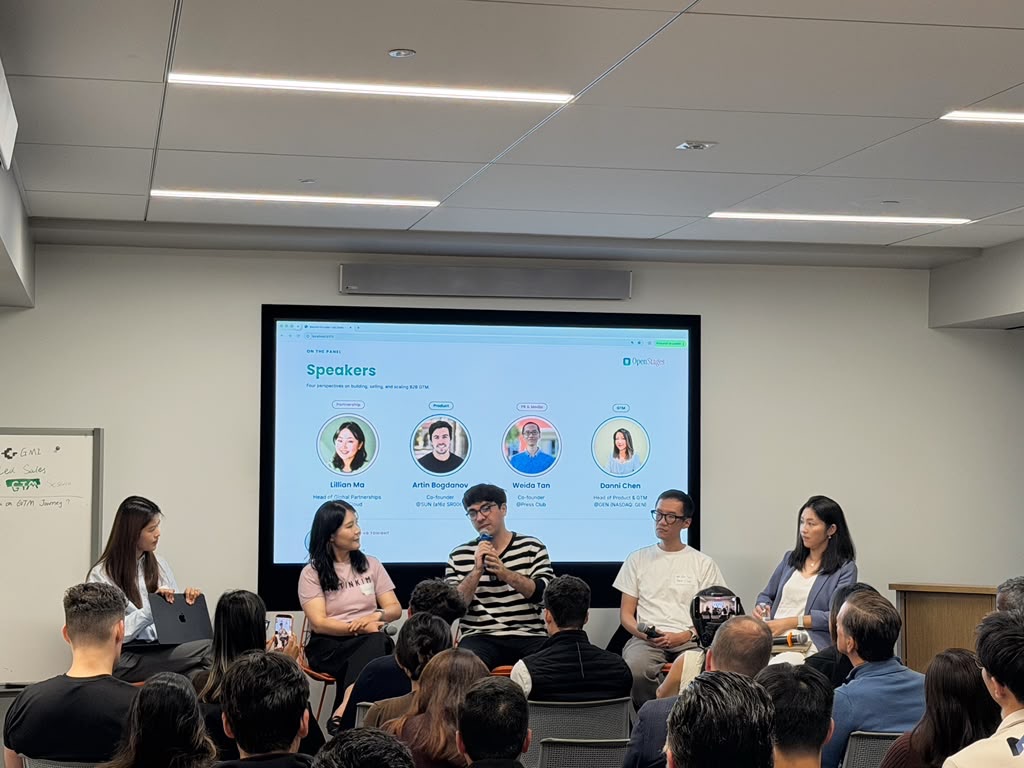
That is the OpenStages motion. Diagnose the company and the ICP. Curate every registration against that ICP. Then pick the form the outcome needs — a 12-person roundtable when the ICP is researchers who never answer cold email; a 100-person salon when the outcome is a three-sided collision; a GTM panel when founders need operators who have already made the jump; a summit when the outcome is category position.
The next one is already set. AI Infra Signal: Build, Operate, and Monetize Intelligence takes the layer both sides of this room kept returning to — infrastructure — and gives it a full afternoon: Sep 12, 2026 in Sunnyvale, 100 application-only seats. If you were in the salon, or wish you had been, this is the one to register for.
The next room
Frequently asked questions
Who was in the room besides the presenting founders?
106 people, screened before doors opened: 113 founder profiles across nine industry clusters, 28 researcher profiles across six research directions, and investors actively deploying into AI from pre-seed through Series B. The salon was cohosted with Inference.ai.
Can my company present at an OpenStages salon?
Yes. OpenStages designs the concept, screens the room, runs the night, and captures what happened afterwards. If you need to meet a specific ICP — researchers, founders, or buyers — tell us who, and we pick the form.