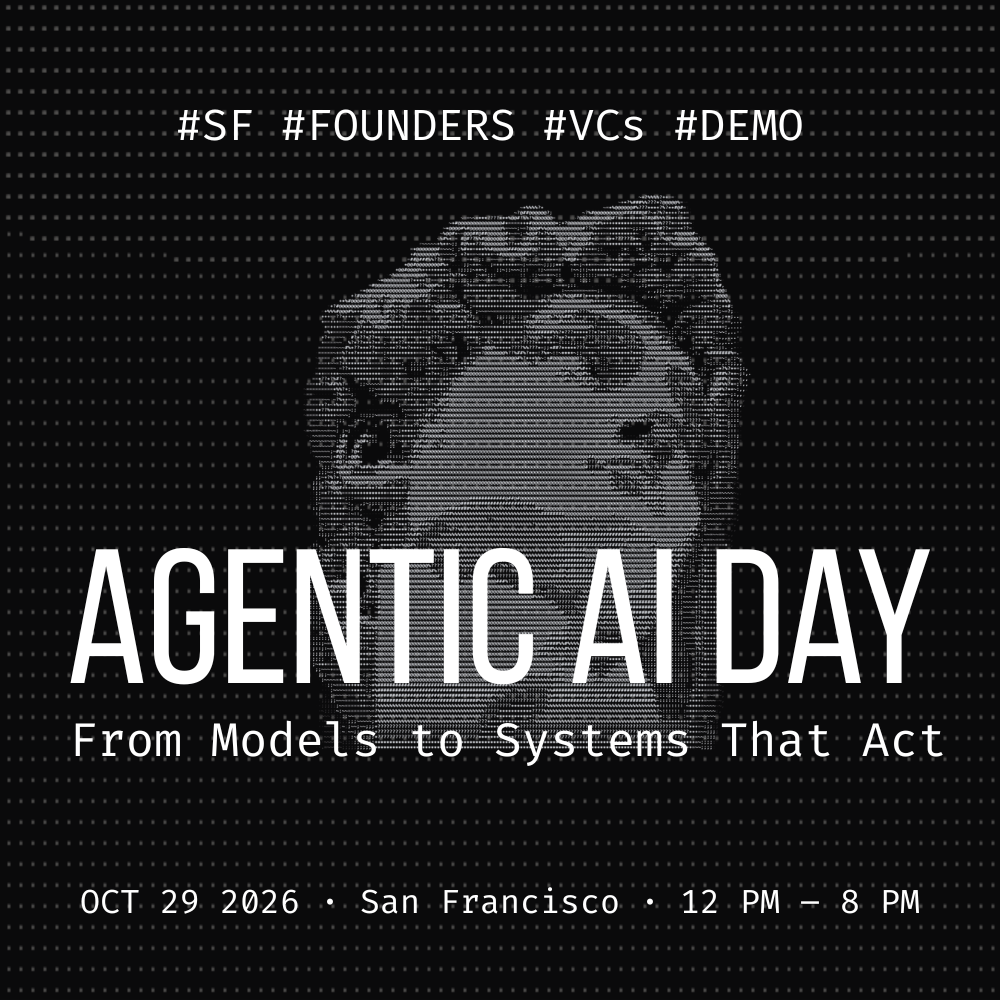
On October 29, OpenStages hosted Agentic AI Day in San Francisco: an afternoon of talks and live demos about what AI agents do once they leave the demo. Twelve teams presented across three rounds, from 2 to 6 PM, to an application-only room.
The premise was simple. Models are already good enough for most of what people want agents to do. What decides whether an agent works in production is everything around the model: the context it carries, the boundary it acts inside, the checks its work passes and the people who stay in charge. Every talk took a position on one of those problems.
This recap groups the twelve talks by the problem each one addressed.
Agents need context that lasts longer than one chat
The most common theme of the day was context. An agent that forgets the decision made yesterday, or never learned how the company works, has to be re-briefed every time.
Context
- 01
Michael Mayernick (Founder & CEO, Structure) — The Company as Source Code
Structure turns a company's mission, roster, standards and roadmap into typed documents on GitHub, compiled into the files that Claude Code, Codex and Cursor read. When one document changes, checks catch the drift across every agent tool. Changes to what the company stands for still require human approval.
- 02
Kobe Wang (Founder & CEO, Echo) — Memory that survives the handoff
Echo is a memory engine that lets agents keep and reuse context across models, tools and workspaces. In the demo, one agent captures a project decision and a second agent recalls it and carries on without a long recap. The source evidence and the permission boundaries behind the recalled context can be inspected.
- 03
Jorge Alcantara (Co-founder & CEO, Zentrik) — Build what your customers want to pay for
Zentrik came at context from the customer side: it helps B2B software teams test and prioritize ideas with their customers, then gives people and AI agents the context to build them.
- 04
Nikhil Tayal (Co-founder & CEO, NoInfra) — From Models to Agents That Do Real Work
Nikhil set out the building blocks of a persistent agent (runtime, identity, memory, connected tools and human approval) and walked through how NoInfra keeps context, and keeps people in control, beyond a single chat.
Agents need a safe place to act
An agent that can run code, open files and call tools needs a boundary that someone other than the agent sets.
Dan Ndombe (Staff Developer Success Advocate, Docker) made the case in Give the Agent Its Own Machine: run the agent at full capability, but inside a boundary you define. The talk was built to end with a setup anyone can recreate on their own laptop in minutes.
Agent work needs to be checked before it ships
If agents write the code, someone has to know when the code gets worse. Two talks were about turning that into an engineering process instead of a gut check.
Checks
- 01
Marcin Michalak (CTO & Founder, AgentX) — AgentX Trace & Eval
An open-source CI/CD pipeline for AI agents. It traces production runs, turns failures into test datasets and scores candidate versions with LLM judges and sandboxed code scorers. A failing version blocks deployment in CI. It is self-hosted, with your own LLM keys, and the data stays inside your infrastructure.
- 02
Sean Shadmand (Founder, Grum) — Catching Design Drift in Agent-Written UI
Grum keeps product design consistent when AI agents write the code. Before Grum, Sean was CIO of IQT (In-Q-Tel), so he has seen enterprise software from the buyer's side.
Agents need the live web
Much of what an agent needs to know is not in its weights or in the company's files.
Reach
- 01
George Trushevskiy (Founding GTM, Keenable) — Giving your agents the live web
Keenable is a web search API built for AI agents. It lets an agent search the live web and read any page as clean text, through a REST API or an MCP server that works in Claude Code, Cursor and Codex.
- 02
Arjun Chintapalli (Co-founder, rtrvr.ai) — Engineering Free Agents: Code Mode, Cache-Maxxing, and Continual Learning
The engineering behind a browser agent that is free to its users. In code mode the model writes one program instead of taking a hundred tool turns, because a for-loop shouldn't cost tokens.
Agents that do a whole job, and agents that meet people
The last group of talks went past infrastructure to what agents look like when they run a business or sit between people.
Whole jobs and people
- 01
Raphael Kalandadze (Co-founder & CTO, Wandero AI) — Be the Decision Maker, Not the Manager
Raphael ran a company's day live. Wandero is an operating system for travel and hospitality built natively on agents, running sales and operations from the first customer email to the final itinerary. He then showed the harness: how the agent gets context, and how its work is checked before a customer sees it. The owner makes the decisions; the agent does the managing.
- 02
Cheryl Yang (Co-founder, HiRey AI) — Beyond the Feed: Personal Agents and the Future of Human Connection
What happens when your personal agent can connect with mine? Cheryl looked at what agent-mediated social networks might look like, and at the role of shared context, mutual intent, consent and follow-through in agent interactions that lead to real relationships.
- 03
Chen-Ping Yu (Co-founder & CEO, Atmanity) — Agents You Can Talk To: Real-Time Human Models on a Single GPU
Atmanity builds a real-time, full-frame human foundation model that lets a person hold a live video conversation with an agent. The talk covered serving it at conversational latency on one GPU, where the cost goes, and why behaviour, not rendering, is the hard part.
What the twelve talks had in common
Put side by side, the talks made one argument: the model is no longer the bottleneck. The work has moved to the layers around it — context, boundaries, checks, reach, and deciding where people stay in charge.
- Context: company knowledge, decisions and customer signal that outlast one session (Structure, Echo, Zentrik, NoInfra).
- Boundaries: a machine, a sandbox or a permission scope that a person sets (Docker, Echo).
- Checks: evaluation in CI, and drift detection on what agents produce (AgentX, Grum, Wandero).
- Reach: the live web and the browser as working surfaces (Keenable, rtrvr.ai).
- People in charge: a human approval step or a hard gate, whether for changes to a company's mission, a release or a customer-facing answer (Structure, AgentX, Wandero, NoInfra).
These teams were not removing people from the loop. They were deciding exactly where people belong in it.
Judges
Every round was judged live by Brett Liu (Investment Lead, Sixty Degree Capital), Benny Liao (Partner, Alpha Intelligence Capital), Sparsh Agarwal (Director of Product Management, Salesforce) and Patrick Blumenthal (VC, Draper Associates).
Partners
Thanks to our strategic partners Infron AI and Fidelity, and our community partners Keenable, HiRey and Glasser.
Keep going
Frequently asked questions
What was Agentic AI Day?
An afternoon of talks and live demos on AI agents in production, held by OpenStages in San Francisco on October 29, 2026, from 2 to 6 PM. Attendance was by application.
Who presented?
Twelve teams: Structure, AgentX, Echo, Keenable, Wandero AI, HiRey AI, Grum, Atmanity, Zentrik, Docker, rtrvr.ai and NoInfra.
What topics did the talks cover?
Agent memory and context, sandboxed execution, evaluation and CI/CD for agents, design drift in agent-written code, web search and browser agents, agent-run operations, personal agents and real-time video agents.
Who judged the talks?
Brett Liu (Sixty Degree Capital), Benny Liao (Alpha Intelligence Capital), Sparsh Agarwal (Salesforce) and Patrick Blumenthal (Draper Associates).