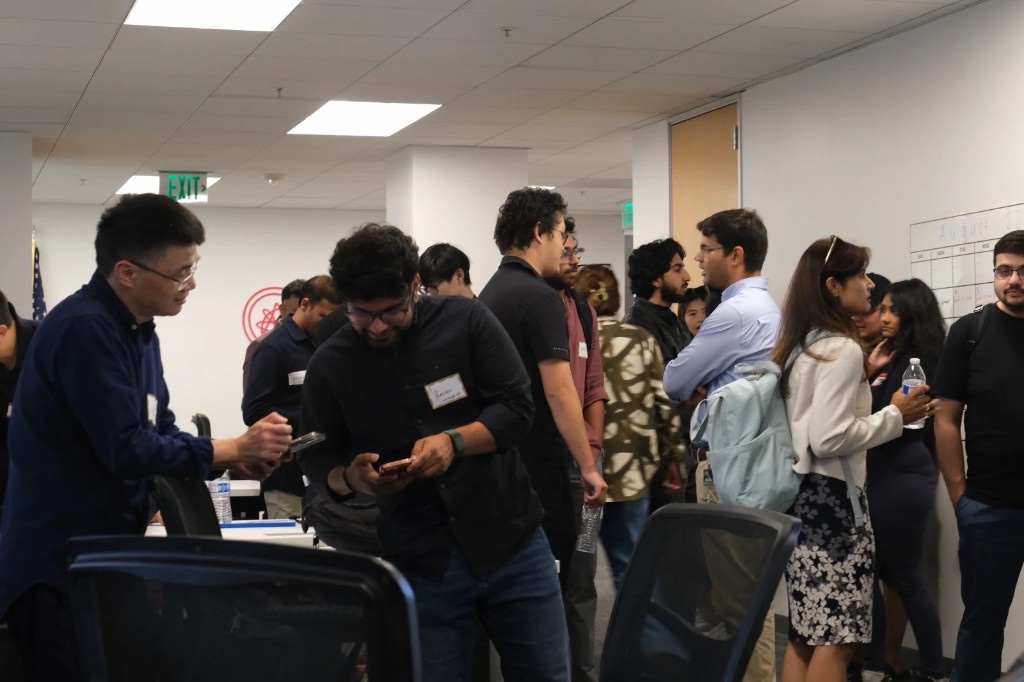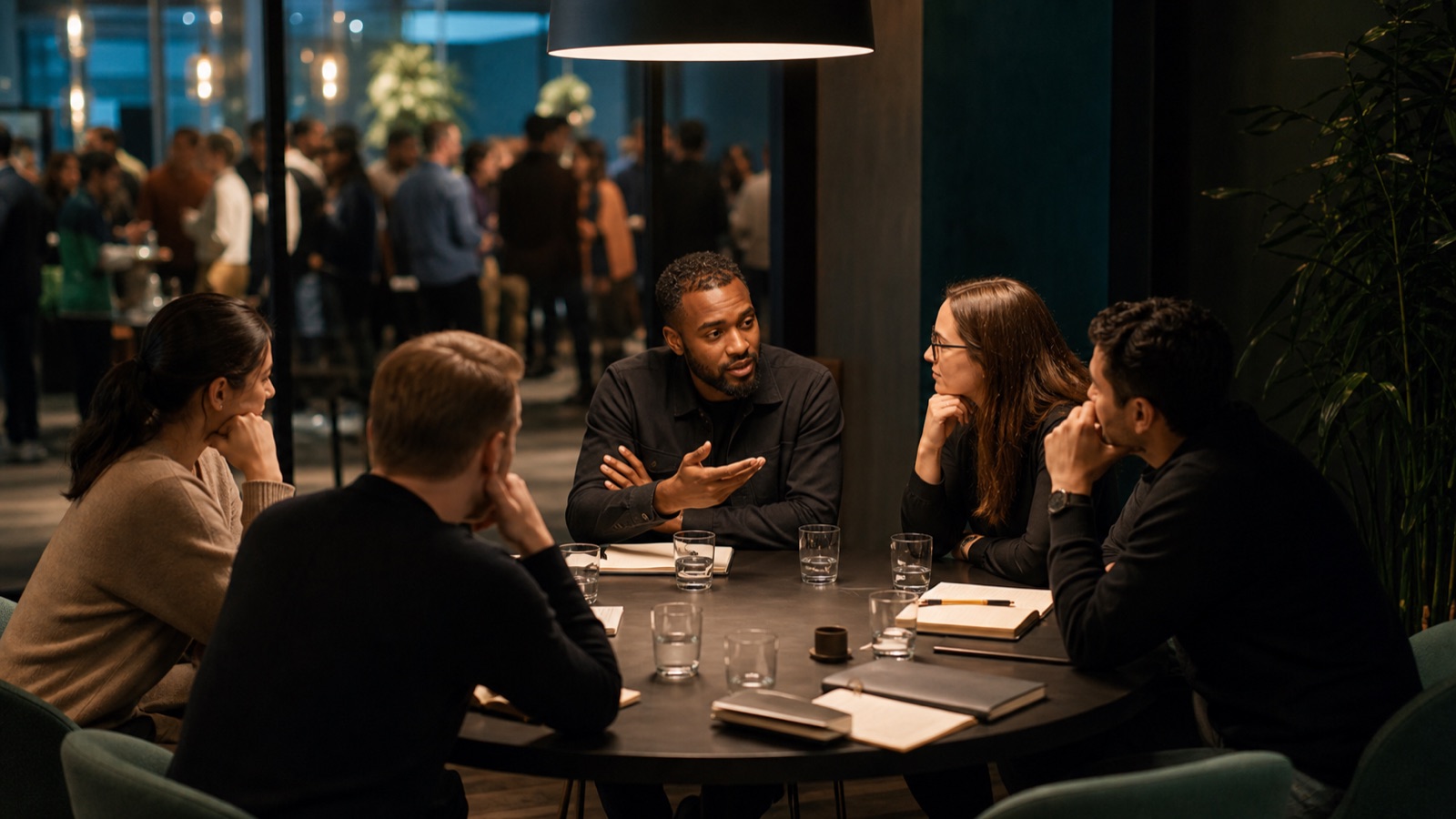
At our first Off the Record: AI Researchers Roundtable, the conversation did not begin with introductions. It began with a deck of playing cards. Researchers, builders, and AI investors from OpenAI, Anthropic, Meta, Google DeepMind, Together AI, Waymo, and other frontier teams entered without public names or titles. Each person received a card and answered two questions: what do you work on every day, and what problem is bothering you most right now?

Take the ideas. Leave the names.
Who was in the room?
The table brought together researchers, builders, and AI investors from OpenAI, Anthropic, Meta, Google DeepMind, Together AI, Waymo, and other frontier AI teams. Participants represented the room only as individuals — not as spokespeople for their employers.
That distinction matters. A company name can establish the technical range in a room without turning the conversation into a series of corporate positions. Nobody was asked to defend a roadmap, speak for a lab, or polish an idea for public release. The purpose was to let people compare problems while those problems were still unfinished.
What did the AI researchers discuss?
The discussion moved across post-training, LLM training and inference, diffusion language models, agent evaluation, multimodal systems, autonomous driving, context management, routing, parallel inference, and applied research. The common thread was not one model or benchmark. It was how these layers increasingly have to work together.
- Post-training and how models become useful beyond a base capability.
- Training and inference infrastructure, including routing and parallel inference.
- Diffusion language models and alternative approaches to generation.
- Context management, memory, and maintaining state across longer tasks.
- Multimodal representation and systems that must reason across different kinds of input.
- Agent evaluation: measuring tool use, persistence, and task completion rather than a single answer.
- Autonomous driving and other applied systems where model behavior meets the physical world.
The shared technical pattern: the stack is becoming one system
As AI moves from producing a single response to maintaining state, using tools, and completing longer tasks, architecture, infrastructure, context, memory, and evaluation can no longer be designed independently.
A model can look capable in isolation and still fail inside a long-running system. The context may be incomplete. A router may send the task to the wrong model. Parallel inference may create speed without coherence. Memory may preserve the wrong state. An evaluation may reward a plausible intermediate answer even when the overall task was never completed. Each layer changes what success means for the others.
Four interfaces that kept resurfacing
- 01
Context and memory
Longer tasks require a system to decide what to retain, what to retrieve, and what to forget. More context is not automatically better context.
- 02
Routing and inference
A useful system needs to decide which model, tool, or compute path should handle each step — while balancing latency, cost, and reliability.
- 03
Multimodal representation
When a task crosses text, images, audio, video, sensors, or the physical world, representation becomes part of the reasoning problem rather than a preprocessing detail.
- 04
Agentic evaluation
A benchmark for one answer cannot fully measure a system that plans, acts, recovers, and uses tools over time. Evaluation has to follow the task, not only the output.
Which research problems could become founder opportunities?
The strongest company ideas often begin as recurring technical problems: workarounds that every team quietly rebuilds, missing evaluation layers, infrastructure that fails at the boundary between models, or research capabilities that have not yet been translated into a usable product.
We asked participants to look at the problem occupying them today and consider what opportunity it might become if they chose to found a company in their next chapter. The question was intentionally exploratory. It was not a startup pitch session, and the room did not try to turn private research into public claims. It created space to notice where independent teams are repeatedly running into the same friction.
That is often where a new category begins. A painful internal tool becomes infrastructure. A fragile evaluation process becomes a platform. A research workflow becomes a product for a much wider set of builders. The useful signal is not that one person has an idea; it is that different people recognize the same unresolved interface from different parts of the stack.
Why remove names and titles?
Anonymity changes what people are willing to say and how carefully others listen. Without a title doing the persuading, an idea has to stand on its own. Without recording or attribution, participants can share an unresolved problem without turning it into a permanent public position.
A public AI panel versus an off-the-record research room
Why the playing cards return
Before leaving, each participant signed their card. We keep those cards for future gatherings. When someone returns, their original card returns with them; a newcomer receives a new identity. It gives the series continuity without turning it into another directory of names and job titles.

The larger goal is simple: create a setting where people can know one another beyond another LinkedIn connection. The next collaborator, co-founder, or close friend may already be at the table. A small private room gives that relationship a better place to begin.
Frequently asked questions
Were individual participants or their comments identified?
No. We name organizations only to describe the range of the room. We do not connect any participant, comment, research direction, or founder idea to a person, role, or employer.
Was the AI researchers roundtable recorded?
No. The room was private, with no recording and no public attribution. This recap shares only the broad topics and patterns that can safely leave the room.
How can I join a future OpenStages roundtable?
OpenStages announces upcoming gatherings through our events page and LinkedIn. Rooms are curated for topic and participant fit so the conversation stays small enough to be candid and broad enough to create unexpected connections.
Continue exploring